





















‘Maddie’s Secret’ pays homage to melodrama and its queer history
I was listening to an episode of The Big Picture podcast recently about the lasting legacy of Mel Brooks (stay with me, here). There is a moment where host Sean Fennessey talks about how, in response to Brooks’ films and other types of parody or satire, mainstream movies began to take on more of an […] The post ‘Maddie’s Secret’ pays homage to melodrama and its queer history appeared first on Rough Draft Atlanta.
I was listening to an episode of The Big Picture podcast recently about the lasting legacy of Mel Brooks (stay with me, here). There is a moment where host Sean Fennessey talks about how, in response to Brooks’ films and other types of parody or satire, mainstream movies began to take on more of an arch, self-aware tone, trying to get ahead of the joke – if they make fun of themselves first, no one else can do it later.
You see this tone all the time in superhero movies, and it has bled into other streams of tentpole, Hollywood filmmaking. But I think this trend has also had an adverse effect on other genres of film. Particularly, melodrama.
Melodrama is an outsized, overdramatic genre that in order to work, necessarily can’t make fun of itself. Even if it leans into camp, or heightens each emotion to its logical endpoint, a good melodrama will still operate with the utmost sincerity. I think this attitude is perhaps starting to fade away, but for years it has felt like, as audiences have become more accustomed to that self-deprecating, almost ironic tone, they’ve lost patience for any hint of earnestness. And so, it feels as though melodrama in its purest form has started to fade away – delegated to Lifetime and not taken as seriously by modern cinephiles or general audiences as it has been in years past.
In March, I reviewed the film “Reminders of Him” – an adaptation of a Colleen Hoover novel that, despite numerous flaws, at least attempted to capture the genre in all its glory. But now, we have a true homage to the likes of melodramatic masters such as Douglas Sirk in the form of “Maddie’s Secret.”

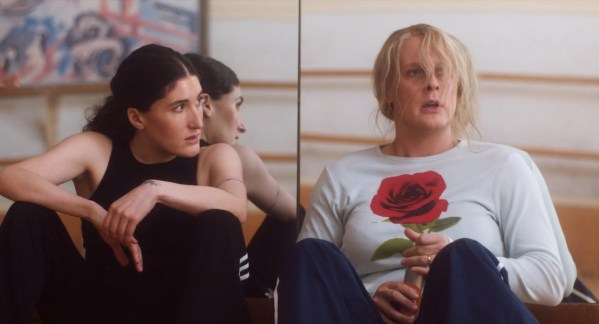
Written by, directed by, and starring comedian John Early as the titular character of Maddie – an online cooking personality who is secretly struggling with bulimia – “Maddie’s Secret” is filled to the brim with humor and camp. But, while I think you’d be forgiven for filing it away in the Lifetime parody bucket while watching its first few minutes, it quickly becomes apparent that “Maddie’s Secret” takes itself incredibly seriously, without a false note or wink at the camera.
Maddie is your quintessential girl next door who works as a dishwasher at Gourmaybe, a test kitchen that puts out shortform content online. But after a video her husband Jake (Eric Rahill) takes of her cooking goes viral, she’s promoted to an onscreen role, quickly rising in the ranks of Gourmaybe’s most popular chefs.
But that newfound popularity also brings old stressors to the surface. In constantly worrying about how she looks on camera and suffering through hardly-veiled insults about her body from rival chef Emily (Claudia O’Doherty) and her own mother, Beverlee (Kristen Johnston), Maddie – who has struggled with bulimia in the past – relapses. Trying to keep her eating disorder a secret only makes things worse.
Early has talked about how his inspiration for “Maddie’s Secret” came in part from the 1986 TV movie “Kate’s Secret” starring Meredith Baxter as a seemingly perfect housewife who is secretly dealing with bulimia. But the look of the film feels almost Lynchian in its use of color and shadow. The film opens on a sequence of Maddie jogging through sunny Los Angeles, the city radiating with a brightness that’s reminiscent of Betty’s (Naomi Watts) arrival to the City of Angels in “Mulholland Drive.” But when Maddie’s eating disorder threatens to overwhelm her, she’s thrown into a shadowed world of deep reds and blues, Club Silencio style.
David Lynch feels like an apt comparison here, as Betty is emblematic of the interplay of light and dark – the perfect girl hiding something darker beneath her smile. Early’s performance echoes the sunniness of that Watts performance. There is, of course, humor baked into that (in that opening scene, Maddie is jogging with her very long hair down – objectively hilarious). But sincerity is by far the more important factor. When Maddie’s friend Deena (a very hot Kate Berlant, playing up an obvious crush on Maddie) drops her off after work one day, she calls out right before Maddie walks through the door: “Don’t you ever get tired of being a good girl?” Maddie laughs and says no – and she really, truly means it.
Maddie is all about effortless perfection, but the interplay between light and dark that she struggles with is a staple of melodrama. Early draws from the greats both in the construction of his performance and the film itself. Maddie is Lana Turner in “Imitation of Life,” willing to sacrifice anything to follow her dreams. She is Elizabeth Taylor in “Suddenly, Last Summer,” dealing with a looming mother figure who seems intent on ruining her life. Towards the end of the film, Maddie delivers a fairly long, expository monologue about her particular trauma when it comes to her mother. While in any other genre the exposition might feel a cheat, here it feels needed – Maddie has spent so much time repressing her emotions, and this monologue finally gives her a moment to feel them at their most potent.
The decision for Early, an out gay man, to play Maddie drives home the queer community’s historic connection to melodrama. Douglas Sirk’s films often critiqued societal norms, focused on the inner lives of middle aged women, and featured queer subtext (and not just because a lot of them starred Rock Hudson). Tennessee Williams, whose plays delivered melodrama in a Southern gothic setting, was gay and explicitly wove queerness into his work.
But the casting decision also has the audience constantly thinking about the idea of performance itself – another huge component of melodrama. So many of these films are about people putting on false faces to the world, or learning how to accept their true selves despite the limits that society places on them. Early captures the idea of that true self and how it relates to performance. It’s never a joke, never something to be laughed at or scorned. Early’s turn as Maddie is so natural, his connection to the material and the historical context in which it exists so strong, that it’s difficult to imagine anyone else giving so much thought and care to the role.
The post ‘Maddie’s Secret’ pays homage to melodrama and its queer history appeared first on Rough Draft Atlanta.
What's Your Reaction?