



















Remembering the Embers: Savannah’s Stories of Destruction and Resilience
Throughout its history, Savannah, Georgia, has faced several devastating fires. The first was recorded in 1737, just four years after the city’s founding. Subsequent fires in 1741 and 1758 prompted the Georgia General Assembly to implement fire safety laws, including banning wooden chimneys, requiring residents to own ladders for firefighting, and establishing a 15-person crew […] The post Remembering the Embers: Savannah’s Stories of Destruction and Resilience appeared first on Savannah, GA | Savannah.com.

Throughout its history, Savannah, Georgia, has faced several devastating fires.
The first was recorded in 1737, just four years after the city’s founding. Subsequent fires in 1741 and 1758 prompted the Georgia General Assembly to implement fire safety laws, including banning wooden chimneys, requiring residents to own ladders for firefighting, and establishing a 15-person crew to operate the city’s fire engine. At the time, firefighting efforts were overseen by Christ Church officials, and additional measures prohibited the boiling of pitch, tar, and turpentine within city limits.
Despite these precautions, a fire in 1796 destroyed over 300 homes, roughly two-thirds of the city, marking one of the worst urban fires in U.S. history at that time. However, for the next 24 years, Savannah avoided major fires until fears arose in the early 19th century as the city became a major lumber-exporting hub. This growing anxiety about fire risks led to increased patrols, particularly after an arson plot targeting a lumberyard was uncovered in 1818.
The Fire of 1820

On January 11, 1820, at approximately 2 a.m., a fire ignited in a livery stable behind a boarding house on Franklin Square. Strong northwest winds and dry conditions caused the flames to spread rapidly through Savannah’s densely populated areas. This included Franklin Square and parts of Bay and Barnard Streets. The fire engulfed wooden structures and several lumber yards, worsening its intensity. When it reached the City Market at Ellis Square, two explosions from illegally stored gunpowder hampered firefighting efforts and caused further destruction.
The fire raged for about eight hours before finally being extinguished around 2 p.m. It destroyed 463 buildings, primarily in Savannah’s central business district between Bay and Broughton Streets and Jefferson and Abercorn Streets. Only a handful of brick structures, including Christ Church and two banks, withstood the inferno. Property damage was estimated at $4-5 million (equivalent to $90-112 million in 2024). The blaze left hundreds homeless and affected two-thirds of the city’s population.
Relief Efforts and Rebuilding
Local and state leaders quickly responded to the crisis. Savannah City Council allocated $1,000 (about $20,000 today) for immediate relief. Mayor Thomas U.P. Charlton appealed to outside groups for financial assistance. Georgia Governor John Clark provided $10,000 (approximately $220,000 today) from a contingency fund. Contributions poured in from private donations, other states and cities, including Charleston, Boston and Philadelphia. Altogether, approximately $99,000 (over $2.23 million today) was raised to support recovery efforts.
Within months, local organizations, including women’s benefit societies, rallied to provide further aid. Churches hosted donation drives, and free food was distributed to displaced residents by local bakers and members of the planter class.
Over the following years, Savannah underwent significant rebuilding. Many of the destroyed wooden buildings were replaced with fire-resistant brick and stone structures. This transformation not only symbolized resilience but also marked a critical step toward improving the city’s infrastructure to prevent future disasters.
Lessons in Ashes for Present and Future Savannah
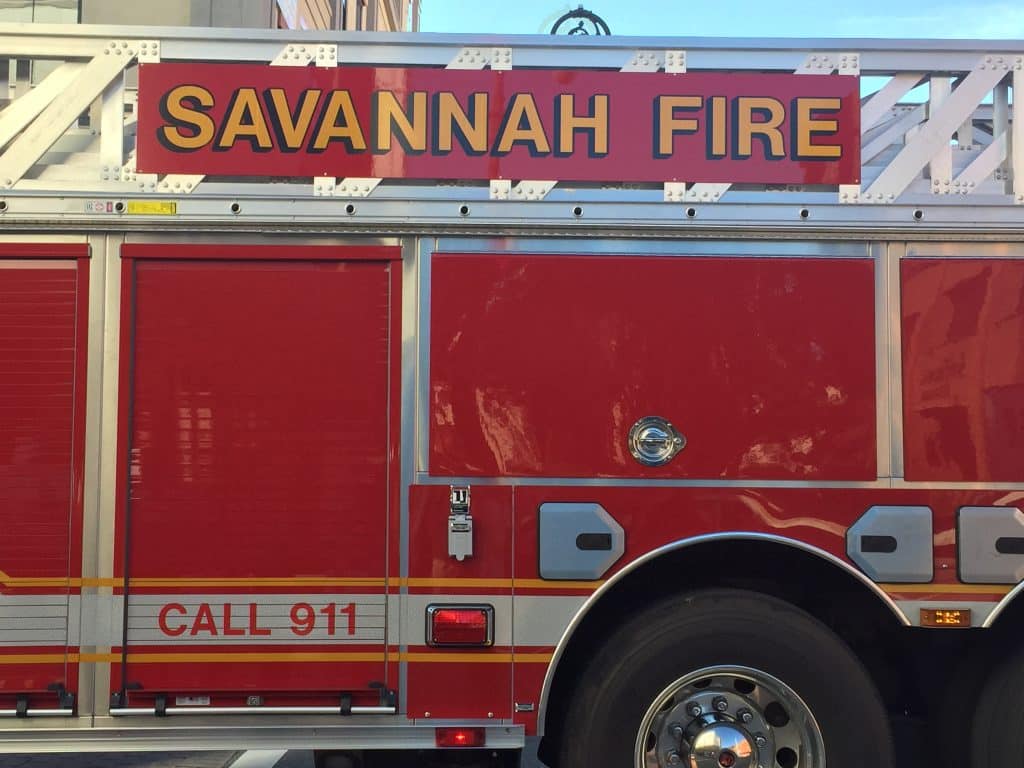
Today, Savannah boasts some truly one-of-a-kind fire trucks, including a recently added Air/Light unit designed by SVI Trucks. Built on a Freightliner chassis, this impressive vehicle is engineered for durability and performance, customized specifically for the Savannah Fire Department. Built on a Sutphen Monarch Chassis with a 20” raised roof, it’s powered by a reliable Cummins L9 engine paired with an Allison EVS 3000 transmission. Equipped with Firetec perimeter lighting and Onscene Solutions slide-out trays and compartment lighting, this truck ensures visibility and accessibility in critical situations. The design also incorporates ample open compartment space, tailored to meet the department’s unique operational needs.
On the front of the vehicle is an alluring feature. If you get to see one of Savannah’s fleet, you’ll notice a retro-looking, pinwheel-like grouping of lights. This is called a Roto-Ray. Savannah Fire Department’s vehicles feature three red, white and blue beacons, spinning at a high speed to ensure maximum visibility. This eye-catching device enhances safety and attention on the scene, making it an essential addition to emergency vehicles.

Sources: https://en.wikipedia.org, https://www.svitrucks.com/savannah-ga-fire-department-heavy-rescue-truck-1021/.
The post Remembering the Embers: Savannah’s Stories of Destruction and Resilience appeared first on Savannah, GA | Savannah.com.
What's Your Reaction?