




























Above the Waterline: Hellbent to see hellbenders
Earlier this year, I had a significant birthday. To celebrate, and also grapple with this dubious milestone, I made a list of seventy-five things I’d never done before, to accomplish, if possible, before the end of this year’s trip around the sun. Embracing my elderly status with new challenges seemed like a good antidote to […] The post Above the Waterline: Hellbent to see hellbenders appeared first on Rough Draft®.
Earlier this year, I had a significant birthday. To celebrate, and also grapple with this dubious milestone, I made a list of seventy-five things I’d never done before, to accomplish, if possible, before the end of this year’s trip around the sun. Embracing my elderly status with new challenges seemed like a good antidote to the “organ recitals” that too often dominate my conversations with friends and family. Talking about coloring my hair with a purple streak, dancing at a salsa club in Quito, or sleeping in a treehouse is much more fun.
My bucket list of new experiences is eclectic. I’ve taken lessons in West African drumming and learned how to row a gondola in a Venetian canal. I’ve hiked in the Dolomites with a wonderful group of strangers, snorkeled at the Galápagos Islands, and listened to the dawn chorus beside the Chattahoochee. Wildlife viewings rank high on my list.
Over the years, I’ve been thrilled and awed by encounters with wild species: a megapod of dolphins performing a stampede; a herd of Roosevelt elk standing in a glacial-fed river at dusk; a circus of Atlantic puffins on a volcanic island; a colony of high-elevation American pikas; and humpback whales engaging in an intense heat run. On my recent trip to the Galapagos, I logged nearly forty new species in just three days. Watching a swallow-tailed gull suddenly regurgitate a small squid and feed it to her chick was an experience of a lifetime–as was snorkeling while gazing down at a hammerhead shark cruising the ocean floor.

I will have to wait until warmer weather next summer for another wildlife adventure that is high on my list: swimming with hellbenders in a cold, clear mountain stream. My destination will likely be the Watauga River in North Carolina, where the local riverkeeper organization is leading conservation efforts to protect this amazing, threatened species.
Giant salamander
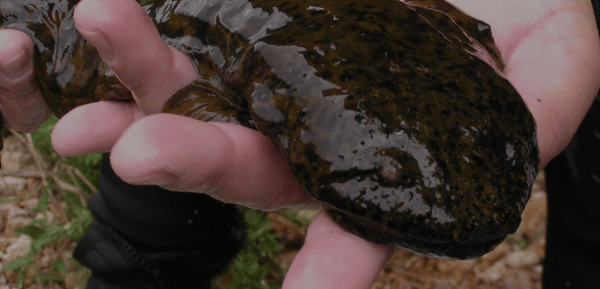
Endearingly known as snot otters, lasagna lizards, devil dogs, and mudpuppies, Eastern hellbenders (Cryptobranchus alleganiensis) are the largest salamanders in North America. An ancient species that lived with the dinosaurs, these amphibians have inhabited Appalachian streams for over 160 million years. They can reach two and a half feet in length, weigh up to five pounds, and live for forty years. While they are capable swimmers, most hellbenders travel over stream beds by walking with toes that help them cling to the bottoms.
Because they breathe through their dark, wrinkly skin–absorbing oxygen straight from the water, hellbenders require clean, swift-moving water, thereby serving as important indicators of a stream’s water quality. They also help maintain healthy aquatic ecosystems by controlling prey populations; however, they are easily affected by pollution. Eroded sediment from development and agricultural operations can cause disease and death. More than 40 percent of known historical populations have vanished in the past few decades. A significant percentage of the remaining populations are in active decline.
In the 1800s, hellbenders were considered vermin: strange, (imagined to be) venomous creatures to be exterminated by shooting with a musket or chopping their heads off. In the early twentieth century, they were believed to be major consumers of game fish populations and targeted through commercial bounty hunting. Industrial pollution, dams, and logging augmented the decline of these harmless creatures as development expanded throughout the Appalachian region. Today, the climate crisis and warmer water temperatures are making their survival even more challenging.
Endangered, but not yet protected
Federal environmental laws brought some protection and attention to the plight of the Eastern hellbender in the 1970s, but their ultimate disappearance from our waterways remains entirely possible. For more than a decade, scientists and conservation groups have tried to get the Eastern hellbender officially listed under the Endangered Species Act. Since its passage fifty years ago, this Nixon-era federal law has helped save nearly 300 species of wildlife in the U.S. from extinction–from the bald eagle and the American alligator to the grizzly bear.
A listing for the hellbender would trigger the need for a consultation between government and private developers, if their project might impact hellbenders, and possibly the issuance of a permit. A small price to pay for clean water, healthy ecosystems, and the survival of a living fossil. Maddeningly, but not surprisingly, the anti-environmental Trump Administration has refused to take reasonable measures to legally protect hellbenders–or hundreds of other endangered species whose listings have been delayed in the past two years.
While this inaction has been frustrating, the truly bad news came several months ago when Trump’s U.S. Fish & Wildlife Service gutted the Endangered Species Act. It’s now legal to destroy the critical habitat of endangered species, or to “take” (or kill) any endangered species, unless such action was “intentional.” Multiple lawsuits have been filed against the administration’s aggressive rollbacks to one of the world’s most successful wildlife conservation laws.
My life–and I’m willing to bet yours as well–has been immeasurably enriched by the wondrous variety of life on this planet. This variety, this diversity of species, must be protected for all of us. As American poet Wendell Berry illustrates with these words, wild things help make our lives worth living:
When despair for the world grows in me and I wake in the night at the least sound in fear of what my life and my children’s lives may be, I go and lie down where the wood drake rests in his beauty on the water, and the great heron feeds. I come into the peace of wild things… For a time I rest in the grace of the world, and am free.”
The post Above the Waterline: Hellbent to see hellbenders appeared first on Rough Draft®.
What's Your Reaction?