


























Art is a relationship in ‘The Christophers’
“The Christophers” opens with a shot of a drawing. Our protagonist, Lori Butler (Michaela Coel), is sitting on a bench, sketching the building across from her. She’s passing time (she works at the Chinese food truck parked next to the bench), and a completed sketch of the same building already sits on one side of […] The post Art is a relationship in ‘The Christophers’ appeared first on Rough Draft Atlanta.
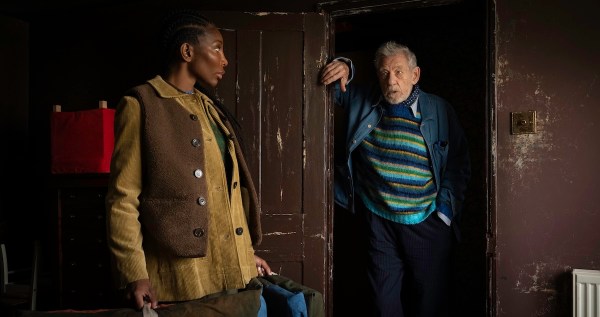
“The Christophers” opens with a shot of a drawing. Our protagonist, Lori Butler (Michaela Coel), is sitting on a bench, sketching the building across from her. She’s passing time (she works at the Chinese food truck parked next to the bench), and a completed sketch of the same building already sits on one side of her notebook, as she works on a second identical sketch.
We won’t really question what Lori is doing until later, but as the film goes on, you start to wonder – was she sketching the building in front of her, or was she trying to copy the sketch on the other page? We’ve been conditioned to understand a difference between those two things, but why? Why does that really matter?
“The Christophers,” directed by Steven Soderbergh and written by Ed Solomon, is filled with moments like this one – seemingly inconsequential at first glance, but raising larger questions about the nature of art. Why do we value the sketch of the building more than the sketch of the sketch? What gives art its importance? Is it originality? And if it is – what does that mean?

We’ll come to learn that Lori has a bit of a reputation for copies – or, if we’re getting technical about it, forgeries. While sitting on the bench, she receives a call from Barnaby (James Corden) and Sallie (Jessica Gunning), the money-hungry children of the world famous, now reclusive artist Julian Sklar (Ian McKellen). Barnaby and Sallie want Lori to finish a set of old, never-seen paintings in their father’s house – the second iteration of an earlier groundbreaking collection called The Christophers, made up of portraits of a man whom Julian was in love with – with the intent of selling them after he dies. There’s only one problem – they’re not done, and Julian, out of pride, or heartbreak, or pure obstinance, refuses to finish then.
“The Christophers” charts Lori and Julian’s ever-evolving relationship with each other and the art they produce in this funny, impeccably acted and surprisingly sweet two-hander that comes down to the idea that art is all about relationships – between the artist and the muse, between the artist and the critic, between the artist and the audience. But those heady ideas are only as strong as the framework of the movie surrounding them. “The Christophers” works on a thematic level because it’s as invested in Lori and Julian’s characters as it is in the idea that meaning can’t come from one person alone.
Once revered, Julian has found himself disillusioned with the capitalistic tendencies of the art world and become a bit of a recluse. He became a household name by playing the part of a nasty judge on an art competition show (think the worst version of Simon Cowell on “American Idol”), and he hasn’t done anything of note in years. He’s the reason Lori wanted to become an artist in the first place – and also the reason that dream started to die.
At this stage in both of their lives, neither Julian nor Lori really consider themselves artistic triumphs. Lori takes the job not because she’s interested in the work itself, but because she wants revenge on the man who ruined her artistic hopes and dreams (as the film goes on, we come to understand how, exactly, he managed that). But when Lori, posing as someone interested in becoming Julian’s new assistant, meets him, it’s hard not to feel a little bad for the man. Lori walks in on him filming Cameos for fans of his Simon Cowell days – how could you not feel pity for a man of such artistic importance brought so low?
Well, just wait until he opens his mouth. Julian’s narcissism is almost blinding, the “interview” he gives Lori mostly consisting of him talking at her before deciding he likes the fact that she doesn’t cut him off well enough to hire her. McKellen is all energy, a rascally twinkle in his eye as he rants about plastics in water, and about how much he hates (but probably secretly loves) when people tell him he’s the reason they became an artist. Coel’s stoicism – she’s all slight modulations and microexpressions filled with tension – is perfectly pitched against McKellen’s vibrancy. Two-handers work better with a little bit of odd couple energy, and these two have it in spades.
“The Christophers” doesn’t linger too much on the secret of what Lori is doing. Julian quickly catches on to Lori’s true purpose, but finds himself far more preoccupied with a bad review of a new collection of his that she wrote years prior. Julian finds himself stuck on the question that comes up so often regarding critics – what gives you the right? He’s haughty and angry, continuously belittling Lori until she offers him a startlingly poignant breakdown of what makes his good work great and his other work middling. As she speaks, level-headed as always, Julian starts to sink down into his chair, the embarrassment of being understood when he thought he was so singular taking over any pride he has left.
Because for Julian, the artistic process has always been individual. He has a feeling, gets the feeling out on the canvas, sends it off and never thinks about it again. When he admits this, Lori stares at him, bewildered. “Where do you think it goes?” she asks.
“The Christophers” feels like both writer and filmmaker reckoning with this very idea. The act of creation, especially something as solitary as writing, or painting, is such a singular experience. But when that singular experience is meant to be seen or read or watched by the masses, it would be naive to say the creation part stops when you’ve put the brush down. Julian’s ego, his years of dressing down aspiring teenage artists on national television, have allowed him to buy into his own genius enough that the idea that anyone could truly understand his work – much less create anything that captures its feeling or essence – is pure fantasy. As he spends more time with Lori, that worldview begins to fall apart.
In “The Christophers,” originality does not lie solely at the feet of the artist, but also in every other piece of work they’ve taken in, in every muse who’s inspired them, in every critic who eviscerated them. Art has never been one-sided, but rather always an ever-changing relationship.
‘The Christophers’ is showing at Midtown Arts Cinema, AMC Phipps Plaza, and AMC Parkway Pointe.
The post Art is a relationship in ‘The Christophers’ appeared first on Rough Draft Atlanta.
What's Your Reaction?